Openers · Haldimand County
Garage Door Opener Replacement
The bedroom above the garage shakes every morning at six when the chain drive fires up. Everyone in the house knows the moment someone leaves for work.
Garage Door Opener Replacement
In plain words
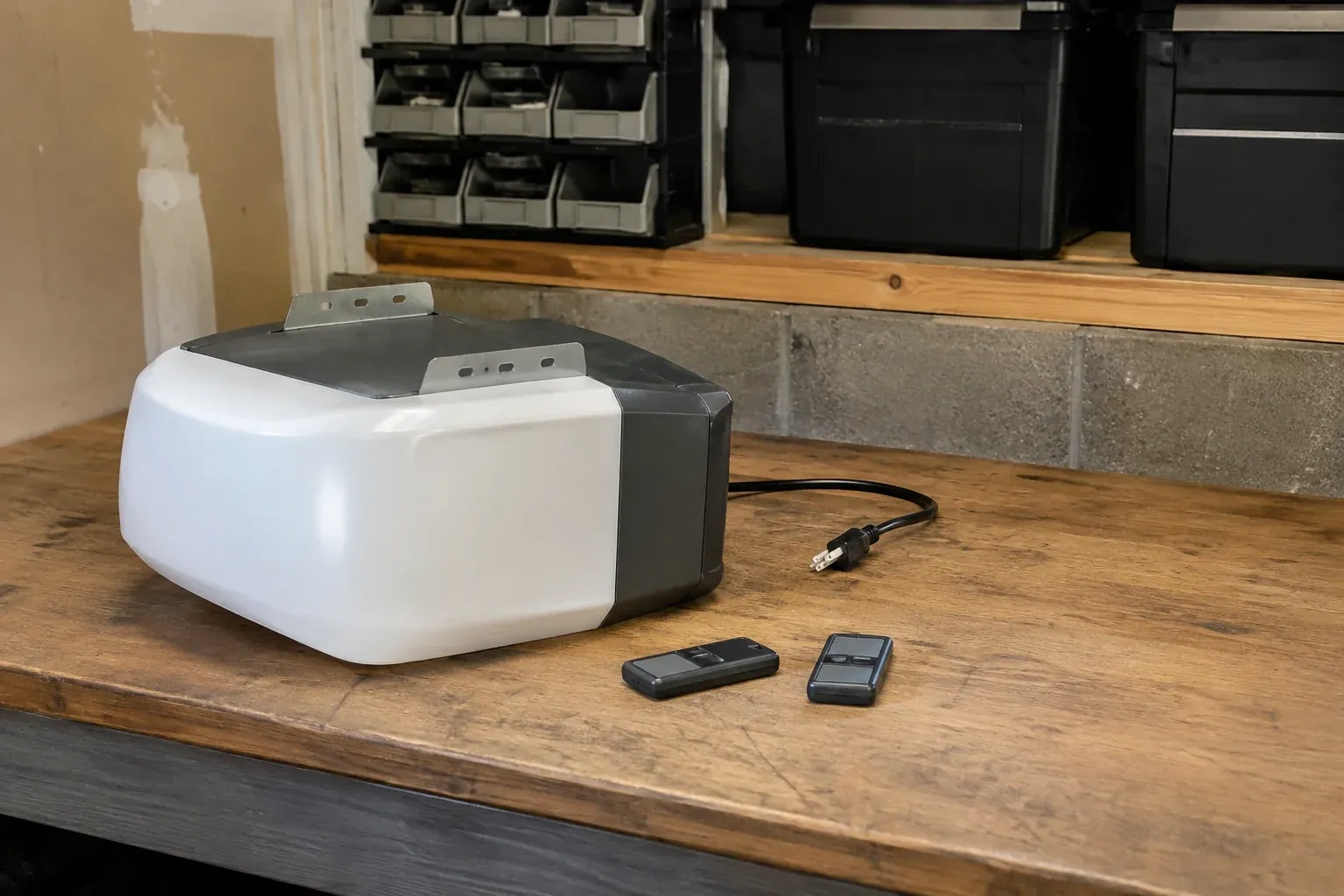
A replacement is also a chance to decide how you want to open the door. Most households leave with a couple of handheld remotes, a wireless keypad by the door for children coming home and a wall console with a light button. The in-car buttons built into many vehicles can be taught the new opener. Wi-Fi models let a phone open, close and check the door from anywhere, and some add a camera or a timer that closes the door if it is left open. Battery backup keeps everything running through a power cut. The technician sets each of these up and shows you how they work.
How the visit goesThe bedroom above the garage shakes every morning at six when the chain drive fires up. Everyone in the house knows the moment someone leaves for work. The door itself is fine; the racket comes from the operator and its steel chain.
Haldimand County
How the visit goes
Lifting the door by hand first
The first check has nothing to do with the opener. The technician unplugs the old unit, pulls the red release so the trolley lets go of the door, and lifts the door by hand. A healthy door rises with moderate effort, stays where it is left about a metre off the floor and comes to rest gently at the top and bottom. That balance is what the new opener depends on, because it moves the door rather than carrying it. If the door is heavy in the hands or drifts down, the springs need attention before any operator is chosen, and that conversation happens now rather than after the new unit is hanging from the ceiling.
Connecting the door to the drive
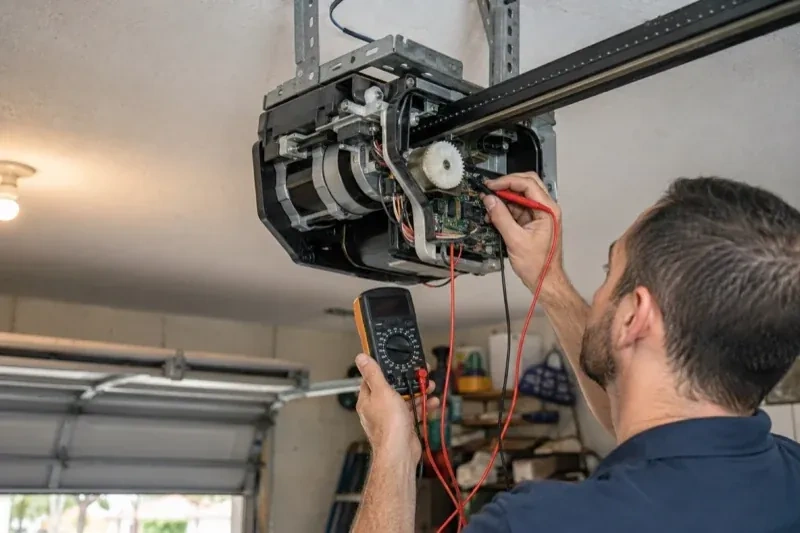
Where the door needs it, a reinforcement strut or operator bracket is fitted across the top section so the pull of the arm is spread over the whole width rather than one point. The door bracket is fastened through the strut into the section, and the straight and curved arm pieces are joined at the length that gives the trolley a smooth angle of pull. The technician reconnects the trolley, runs the door partway by hand and watches the arm geometry through the top of the travel, since a poorly angled arm is a common cause of a door that shudders or bows at the top.
Keeping the door balanced under the new operator
The new operator will run for many years if the door it moves stays balanced. Once a season, pull the release with the door closed, lift it by hand to about a metre and let go: it should stay there. If it drops or creeps upward, the springs have drifted and want a tune before the operator starts working harder to compensate. Watch too for a door that pauses or jerks at one point in its travel, which is usually a roller or a track bracket rather than the motor. A yearly service visit that checks balance, cables, rollers and the safety tests keeps both the door and the operator in step with each other.
Garage Door Opener Replacement
In the van
- Low-voltage bell wire and staples
- Top-section reinforcement strut
- Wall control console
- Header bracket and lag screws
- Perforated angle iron hangers
What affects the quote
Same fees day, night or weekend
1Motor rating for the door
An uninsulated single steel door and a heavy double door in insulated steel or solid wood call for different motor ratings, and the heavier door's operator is a larger piece of equipment.
2Top-section reinforcement
Lightweight steel, glazed and wide doors need a strut or operator bracket across the top section before the arm is attached, so the pull is spread across the door rather than concentrated at one point.
3Battery backup
A backup battery, whether built into the head or added as a module, is an option that carries its own line, along with the renewal battery it will want every few years.
Garage Door Opener Replacement: questions
What is a wall-mount opener and who is it for?
It is the operator that lives on the wall rather than the ceiling. Fixed where the torsion shaft ends, it rotates the shaft to raise and lower the door, and nothing hangs overhead. It suits cathedral and low ceilings, garages with lofts or lifts, and anyone who wants a very quiet door. Because there is no trolley holding the door shut, it comes with a powered deadbolt on the track and a monitor that stops the door if a lift cable slackens.
The door is frozen to the floor. Why does the opener reverse?
Because the operator is protecting the door. Its force setting is tuned to the small effort a balanced door needs, so a seal glued to the concrete by ice registers as an obstruction and the door heads back up rather than ripping the rubber or bowing the top panel. Loosen the seal with a plastic scraper or a hair dryer along the sill, then try again; a shovelled threshold before a cold night keeps it from recurring.
Chain or belt: which should I choose?
Both move the same doors, so the choice is about sound and setting. Chain is the sturdy, simple workhorse and a fine fit for a detached garage or a workshop where a little noise is nobody's concern. Belt is the pick when a bedroom, nursery or office shares a wall or floor with the garage, because it starts and stops softly and hums rather than rattles. If the ceiling is crowded, a wall-mounted unit beside the spring shaft removes the rail altogether.
Openers & Access
- Chain-Drive Opener RepairThe door closes, touches the floor, then climbs straight back up as if it hit something.
- Belt-Drive Opener RepairIt is minus twenty in the detached garage and the door climbs in jerks, the belt stiff as a board.
- Photo-Eye Sensor Alignment or ReplacementThe small light on one of the sensors near the floor has gone dark, or it flickers when someone…
Garage Door Opener Replacement near you
For homes and businesses in Haldimand County we handle the full run of garage door work: broken springs and cables, doors that have left the track, openers and remotes that stopped answering, worn rollers and seals, tune-ups, and new doors chosen and installed to suit the building.