Openers · Haldimand County
Garage Door Remote and Keypad Programming in Haldimand County
Someone in the family tried to add a remote, held the button on the ceiling unit a little too long, and now every remote in the house is dead at once. The wall control still moves the door.
Garage Door Remote and Keypad Programming
In plain words
Older openers set their code with a row of tiny switches inside the remote and the receiver, and once those remotes stop being made the door seems stranded. It is not. An add-on receiver wires to the same two terminals as the wall button and plugs into the ceiling outlet, giving the old motor a modern rolling-code radio along with new remotes and a keypad. The door mechanics stay as they are, provided the opener already has photo eyes near the floor. Where it has none, the conversation turns to a new opener, and the reasons are explained plainly.
How the visit goesThe opener is an older one with a row of tiny switches inside the remote. The last remote finally died, the maker stopped selling that model years ago, and the door itself still runs perfectly from the wall button.
Haldimand County
How the visit goes
Which generation is this opener?
Under the light cover of the head unit, near the antenna wire, sits the learn or program button. Its colour on many makes and the model label beside it tell the technician which radio generation the receiver belongs to, and that decides which remotes and keypads can ever be paired with it. Most openers from the mid-1990s onward use rolling codes, earlier ones often fixed codes set by switches, but age alone does not confirm which; the model settles it. The accessory in hand is compared against the maker's compatibility list before its packaging is opened. Ten seconds with a ladder here prevents an afternoon of pressing buttons on a remote that was never going to work.
Adding a remote to the memory
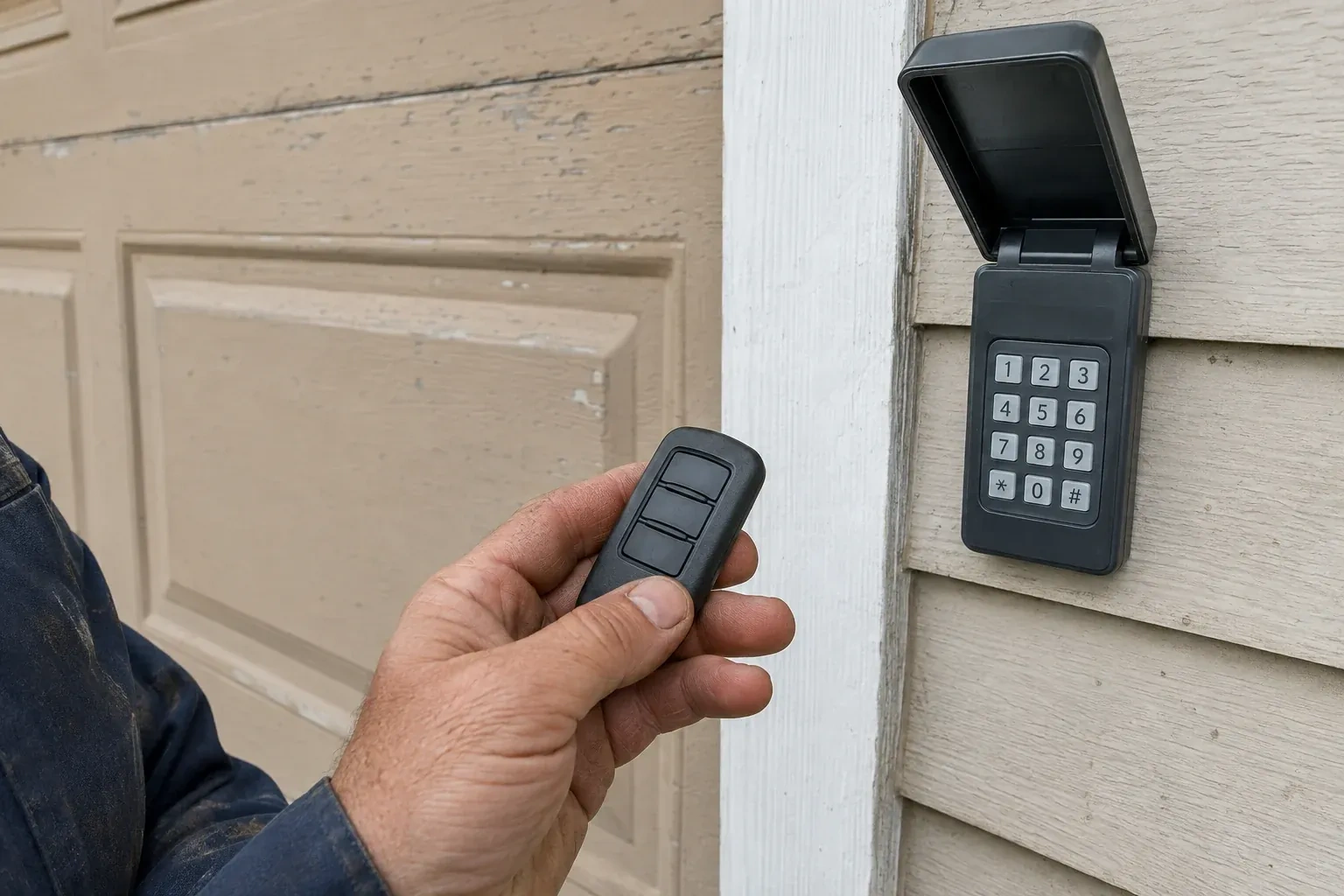
With a compatible remote in hand and the opener confirmed ready, pairing is a short exchange. The technician presses and releases the head unit's learn button, which opens a programming window of roughly half a minute, then presses the chosen remote button until the opener light blinks or the unit gives a click. That button now opens the door. A second button can be tied to a second door or a gate the same way. Each remote is tested from the driveway and from beside the door, and the process is repeated for every device on the list so nobody is left with a control that half works.
An older opener with a modern radio
If an add-on receiver was fitted, your original motor and rail carry on as before while a small box near the head unit does the listening. You have new remotes and a keypad that use rolling codes, so the door no longer answers a fixed code that any similar remote might share. The receiver's power plug and its two thin wires to the wall-button terminals are shown to you so nothing is unplugged by accident. The photo eyes that made this upgrade possible are checked and their monthly test explained, since they remain the door's main protection.
Garage Door Remote and Keypad Programming
In the van
- Universal multi-generation remote
- Replacement remote (one, two or three buttons)
- Keypad mounting screws and anchors
- Multi-door keypad
- CR2032 and CR2016 coin cells
What affects the quote
Same fees day, night or weekend
1Compatibility of the accessory
A remote matched to the opener's generation is programmed as it is. One of the wrong generation is swapped for a compatible or universal model, and that device is a separate line.
2Vehicle buttons to train
Vehicle programming is quoted by the actual vehicle and opener combination, since not every built-in system uses the same steps; an older vehicle that needs a bridge module adds that part.
3Receiver or logic board fault found
If a known-good remote also fails, the receiver or board is the cause; its diagnosis and replacement are quoted separately from programming.
Garage Door Remote and Keypad Programming: questions
Why does my remote work only when I am right under the door?
Short range is a signal problem, not a pairing problem. LED bulbs in the opener's own sockets can emit radio noise that swamps the receiver, an antenna wire tucked into the housing cannot hear well, and a coin cell near the end of its life transmits weakly before it dies. Swapping the bulb, letting the antenna hang free and fitting a fresh cell usually restore range; if not, the receiver is checked.
My older car's button will not learn my new opener. Why?
Some in-car systems from earlier model years cannot hear the newest opener radios directly. The usual answer is a small compatibility bridge module that pairs with the opener and relays the car's signal, or a handheld remote clipped to the visor. The technician identifies the car's system and the opener's generation and chooses whichever gives a reliable result.
Do I need to be home for the programming visit?
Yes, for two reasons. The technician confirms that the person authorising changes to the door's access is the owner, a tenant with permission or the building manager, and you choose the keypad code yourself so it is never known to anyone else. You also test each control in your own hand before the visit ends. Have every remote and vehicle you want programmed available, since a car parked elsewhere cannot be trained.
Openers & Access
- Chain-Drive Opener RepairThe door closes, touches the floor, then climbs straight back up as if it hit something.
- Belt-Drive Opener RepairIt is minus twenty in the detached garage and the door climbs in jerks, the belt stiff as a board.
- Garage Door Opener ReplacementThe bedroom above the garage shakes every morning at six when the chain drive fires up.
Garage Door Remote and Keypad Programming near you
For homes and businesses in Haldimand County we handle the full run of garage door work: broken springs and cables, doors that have left the track, openers and remotes that stopped answering, worn rollers and seals, tune-ups, and new doors chosen and installed to suit the building.